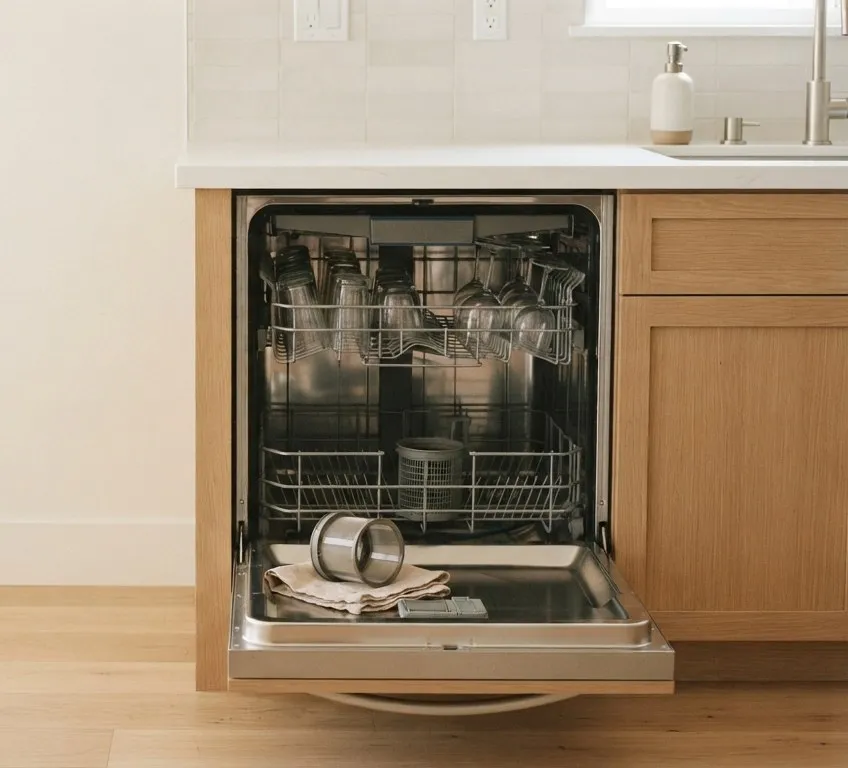
You open the door at the end of the cycle and find cloudy glasses, a gritty film on the plates, or an inch of gray water sitting over the filter. Dishwasher repair in San Jose often starts with one of those, and the first job is working out whether you have a broken part or a water problem. San Jose Appliance Care connects households in San Jose and nearby cities with local repair companies for built-in, panel-ready, drawer and standard 24-inch dishwashers. Tell us the brand and ZIP code, and we’ll connect you with a company that works on that model.
Hard water and your dishwasher
Hard water is the first thing to rule out in a San Jose kitchen. San Jose Water, one of the utilities serving the city, defines hard water as anything above 7 grains per gallon (120 parts per million). Its own figures put local groundwater at 11 to 26 grains per gallon, mountain surface water at 5 to 12, and imported surface water at 4 to 9. The minerals are calcium and magnesium, and the utility says they show up as scale in kettles, residue on fixtures and spots on dishes.

In a dishwasher, those minerals end up as a film on glasses, plates and the tub itself. GE adds a twist: today’s phosphate-free detergents are part of why white film appears, and it’s most common in hard water areas. So a film problem is usually chemistry, not a failed part.
Other cities in the service area, and some San Jose neighborhoods, are served by different water systems with their own hardness figures in their annual water quality reports. Look yours up before you blame the machine.
Fixing film before calling for repair
- Use rinse aid. Bosch describes rinse aid as a surfactant that helps water slide off dishes, prevents spots on glasses and cutlery in hard water areas, and speeds drying. If you see rainbow streaks, you’re using too much; water spots mean too little. The dose is adjustable in the settings.
- Descale the tub. GE suggests running a full cycle with citric acid in the detergent cup and no detergent, or adding a cup of vinegar right after the detergent cup opens.
- Try a better detergent. GE recommends quality dishwasher cleaners and detergents for film problems.
If the film comes back within a week, or the spray arms are visibly clogged with scale, a technician can clean or replace the arms and check the heating element and wash pump. And if you’re weighing a whole-house water softener, note San Jose Water’s cautions: softeners need regular maintenance, a malfunctioning unit can lower water pressure, and the salt used in them can corrode household plumbing.
Dishwasher not draining: standing water after the cycle
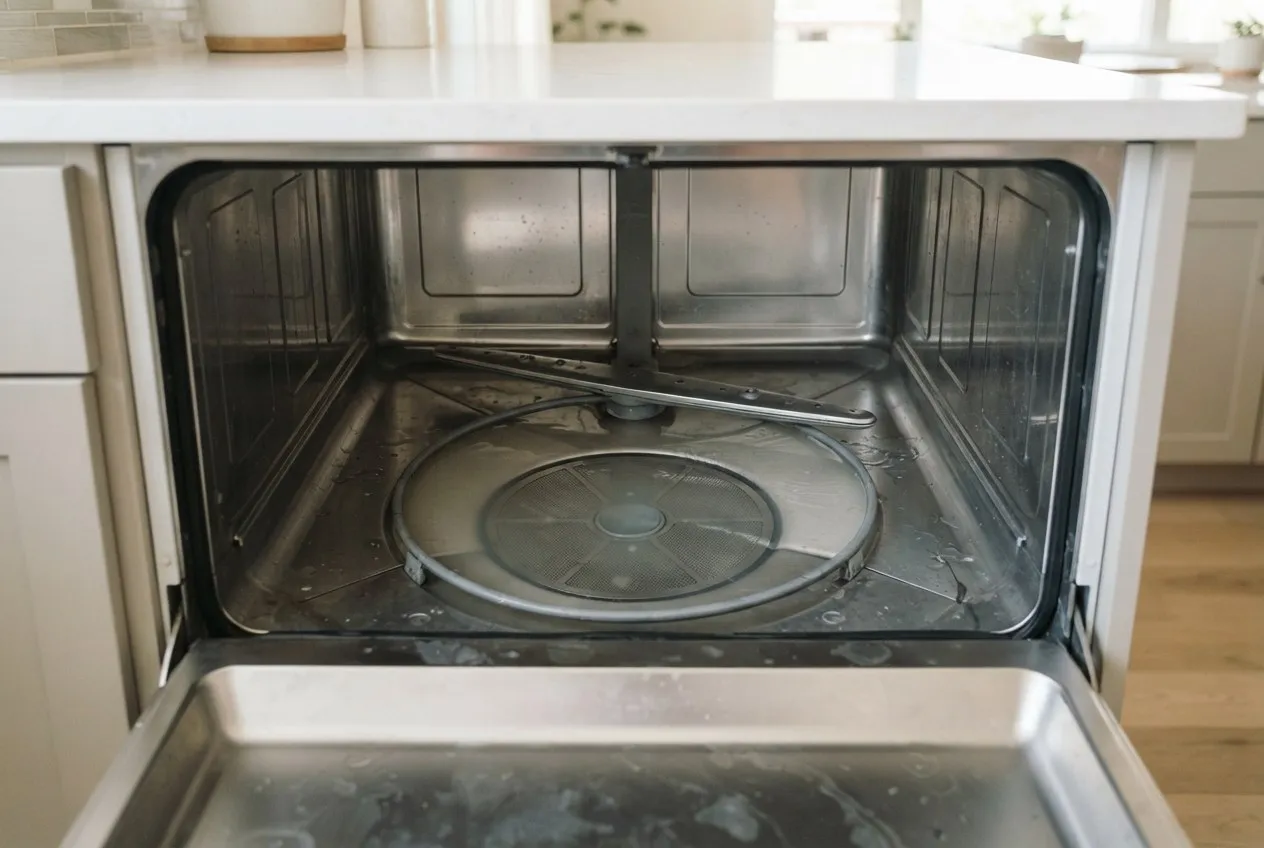
Whirlpool’s drain troubleshooting points to a short list: a clogged filter, food debris in the sump, a kinked or crushed drain hose, a blockage at the garbage disposal or sink connection, a jammed drain pump or impeller, and less often a failed drain solenoid, timer or control board. How much water is left tells you something. A small amount above the filter suggests a partial restriction; water up near the door opening suggests a severe blockage.
Check these yourself first:
- The filter. Twist it out of the tub floor, rinse it under warm water and scrub off residue with a soft brush.
- The drain hose. Under the sink it should rise in a high loop fastened to the underside of the counter, or run through an air gap on the sink deck. Both stop dirty water from flowing back into the tub.
- The disposal. Most built-in dishwashers drain through the garbage disposal. KitchenAid and Whirlpool both warn that a newly installed disposal has a knockout plug in its dishwasher inlet that has to be removed. Their test: slide a pencil into the inlet. If it goes about 3 inches, the plug is out. If the disposal itself is jammed or humming, our garbage disposal repair page covers that side.
If all three are clear and you can’t hear the drain pump running at the end of the cycle, the pump or its controls need a technician.
Water on the kitchen floor
A leak usually comes from one of three places: the door, the connections underneath, or suds.
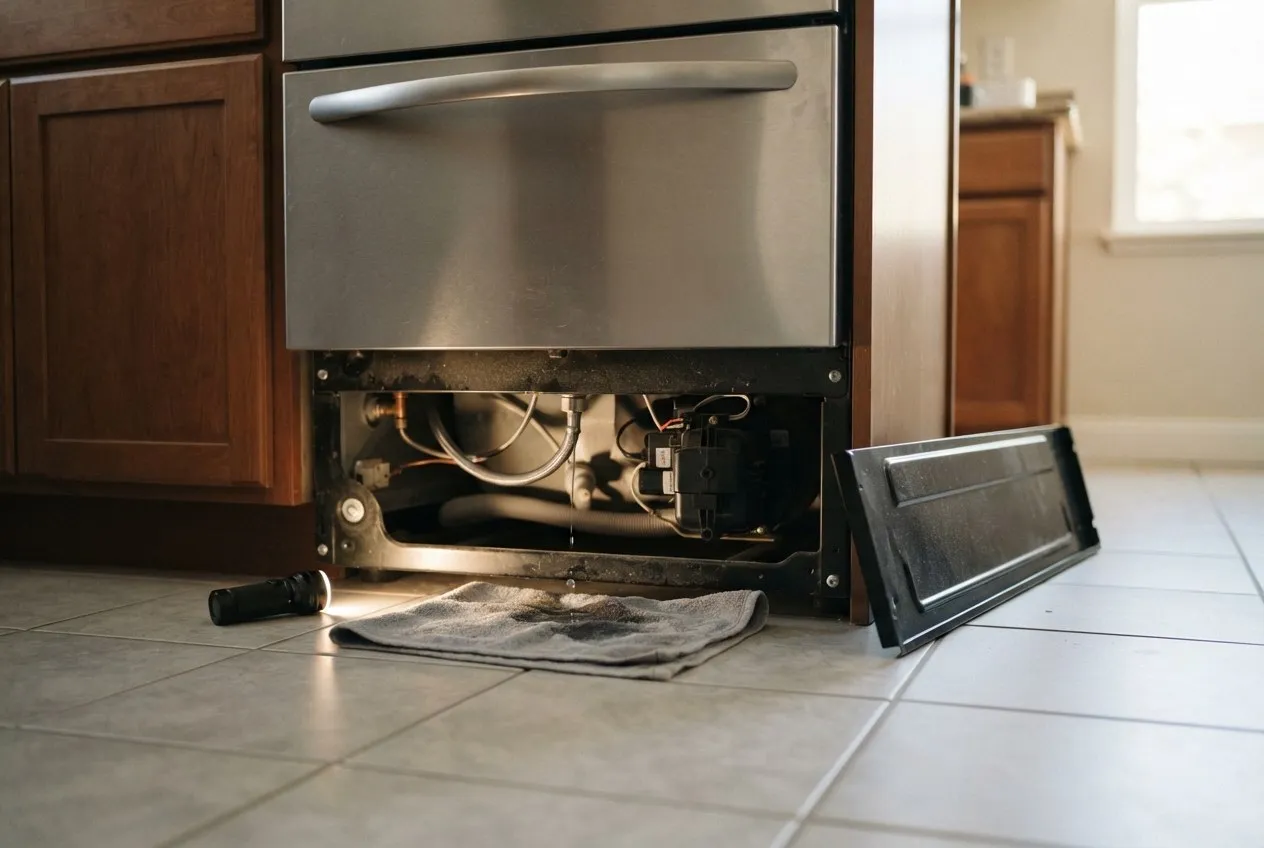
Suds are the surprise. GE says using the wrong type or too much detergent can create enough foam to push water out past the door and flood the floor. Only automatic-dishwasher detergent belongs in the machine. Hand dish soap left on pre-rinsed plates, or rinse aid spilled on the door, can cause the same thing. GE’s fix: add cold water to the tub and run a drain, and if the foam won’t settle, sprinkle a few tablespoons of non-dairy coffee creamer over the suds, wait five minutes and drain again.
If there are no suds, look at the door gasket for tears or trapped debris, and check under the unit for a wet supply line, drain connection or pump seal. Turn off the water supply valve under the sink and the circuit breaker if water is reaching the cabinet or flooring. A leak under a built-in is worth fixing fast, because the water sits where you can’t see it.
Not cleaning, not drying, or not starting
- Poor cleaning with no hard water signs usually points to a clogged filter, blocked spray arm holes, or a weak wash pump.
- Wet dishes often come down to rinse aid first. Beyond that, the heating element, fan or vent (depending on the model) may be the fault.
- No start can be a door latch that doesn’t register as closed, a control lock left on, or a failed control board. Look in the manual for the control lock before booking a visit.
If the display shows an error code, write it down. The appliance error code library lists manufacturer meanings, and the technician will want it too.
Repair prices and the replacement line
Fixr’s national numbers give a sense of scale. Local San Jose quotes can run differently, so use these to check an estimate, not predict it.
| Repair | National range |
|---|---|
| Seal or gasket | $50-$150 |
| Door spring | $50-$150 |
| Pump | $150-$400 |
| Control panel | $200-$500 |
| Motor | $400-$600 |
By problem, Fixr lists leaks under the door at $50-$300, won’t-drain at $50-$400, won’t-start at $100-$600 and bad odor at $50-$400. The national average is about $200, most repairs fall between $100 and $300, and diagnostic fees run $50-$75.
Fixr’s rule of thumb: a repair costing more than half the price of a new model probably isn’t worth it. New dishwashers typically run $400-$700, plus $100-$300 to install. Most last 8 to 10 years, while high-end models can reach 15 to 20 with good care, which changes the math on a Miele or a Thermador. The repair or replace guide and the cost guide go further.
Two local notes if you’re leaning toward replacement. Valley Water doesn’t offer dishwasher rebates. It does point out that washing dishes in a new ENERGY STAR dishwasher rather than by hand can save up to $40 a year.
California’s repair dealer law applies here the same as for any major appliance: you get the diagnostic fee in writing before the work in your home, and a written estimate for parts and labor before any repair. The company can’t go over that estimate without your consent.
Built-in and panel-ready brands covered
Covered dishwashers range from standard 24-inch Whirlpool, GE, Samsung, LG, Maytag and Frigidaire units to European built-ins from Bosch and Miele, panel-ready models from Thermador and KitchenAid, Cove dishwashers from the Sub-Zero Group, and Fisher & Paykel dish drawers. If yours is panel-ready or fully integrated, say so when you call, since the cabinet panel is part of the job. Owners of Thermador or Samsung units can check warranty terms first on our Thermador repair and Samsung repair pages.
Kitchens across the service area
Dishwasher calls are matched by ZIP code across San Jose and the ring of cities around it: Palo Alto and Mountain View to the northwest, Sunnyvale, Santa Clara and Cupertino in between, Milpitas and Fremont to the north and east, and Los Gatos to the south. Water supply differs from one to the next, which is one more reason to read your own utility’s hardness figures before deciding whether a film problem is a part or the water. Kitchen remodels also vary: a newer panel-ready install and a twenty-year-old builder-grade unit are very different jobs, so describe what you have.
What to have ready when you call
Find the model and serial number on the label along the edge of the door or tub. Note the symptom and when it started, whether the kitchen has a garbage disposal or an air gap, and any code on the display. If water is standing in the tub, leave it for the technician to see. Then call with your ZIP code, and we’ll connect you with a local dishwasher repair company that covers your area.