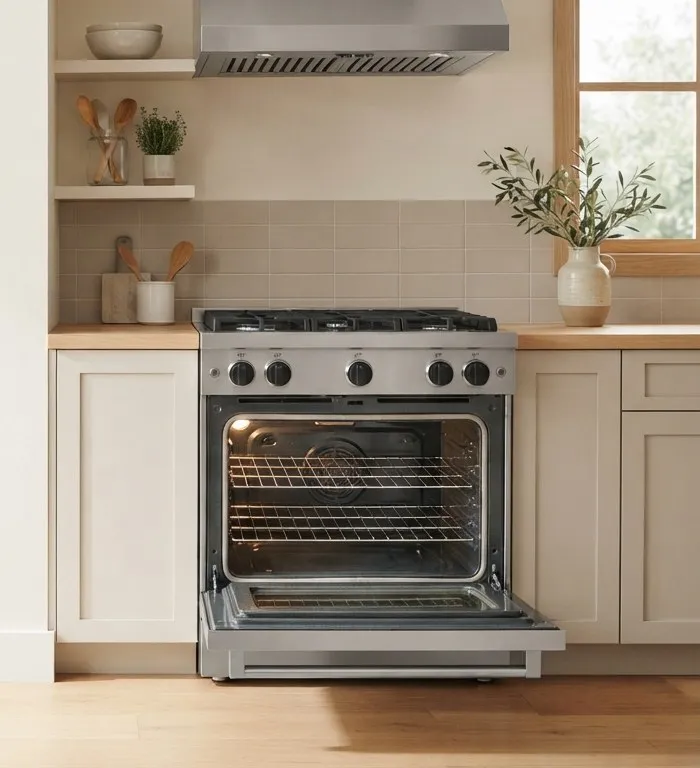
San Jose Appliance Care connects households with independent local companies for oven repair in San Jose, along with range repair and stove repair, covering gas and electric models from freestanding ranges to built-in wall ovens and pro-style ranges. The problems behind most calls are familiar: an oven that won’t heat, a gas burner that clicks without lighting, an oven that runs 40 degrees off, or a control panel that has gone dark. This page matches those symptoms to the parts that usually cause them, explains what the repairs cost nationally, and covers the safety steps that come before any repair.
Smell gas? Stop here. PG&E’s instruction is to leave the area now and call 911, then call PG&E at 1-800-743-5000. Don’t use light switches, matches, flashlights or anything else that could spark until you’re a safe distance away. PG&E adds a sulfur-like, rotten-egg odor to natural gas so even small leaks are noticeable. An appliance repair visit comes after the utility or fire department has made the house safe.
Gas or electric changes the whole diagnosis
The first question a technician asks is which fuel the range uses, because the two designs fail in different places. A gas oven heats with a burner lit by an igniter and fed through a safety valve. An electric oven heats with a bake element on the floor of the cavity and a broil element at the top. Both rely on a temperature sensor and a control (a board or, on older models, a mechanical thermostat) to decide when to heat.
| What you notice | Gas range: usual cause | Electric range: usual cause |
|---|---|---|
| Oven stays cold, cooktop works | Weak bake igniter or gas valve | Burned-out bake element |
| Oven heats but runs hot or cold | Temperature sensor or thermostat | Temperature sensor or thermostat |
| Broiler dead, bake works | Broil igniter | Broil element |
| Display blank, nothing responds | Tripped breaker, then control board | Tripped breaker, then control board |
| One burner won’t light or keeps clicking | Wet or clogged burner, misplaced cap | Not applicable; see element below |
| One surface element won’t heat | Not applicable | Element, switch or connection |
Some parts cross over. Many gas ranges still use an electronic control board, and a board failure looks the same on either fuel: no response, or error codes on the display.
Oven symptoms, matched to the part
The gas oven won’t heat but the burners light
This is the classic weak-igniter case. A glow-bar igniter has to heat up and draw enough current to open the oven’s gas safety valve. As it ages it can still glow orange while never drawing quite enough current, so the valve stays shut and the oven stays cold. HomeAdvisor’s guide describes the same relationship: unless the igniter is glowing properly, the valve won’t open and gas won’t reach the burner.
GE’s own troubleshooting sequence is worth running before you call. Check that the controls are set correctly and the breaker is on. Confirm the gas shutoff valve behind the range is open. Set the oven to Bake, open the door and look for a red glow near the back of the oven floor. On models with a self-clean latch, make sure it’s in the unlocked position. If you see no glow, or a glow that never lights the burner, the next step is a technician with a meter.
The electric oven won’t heat
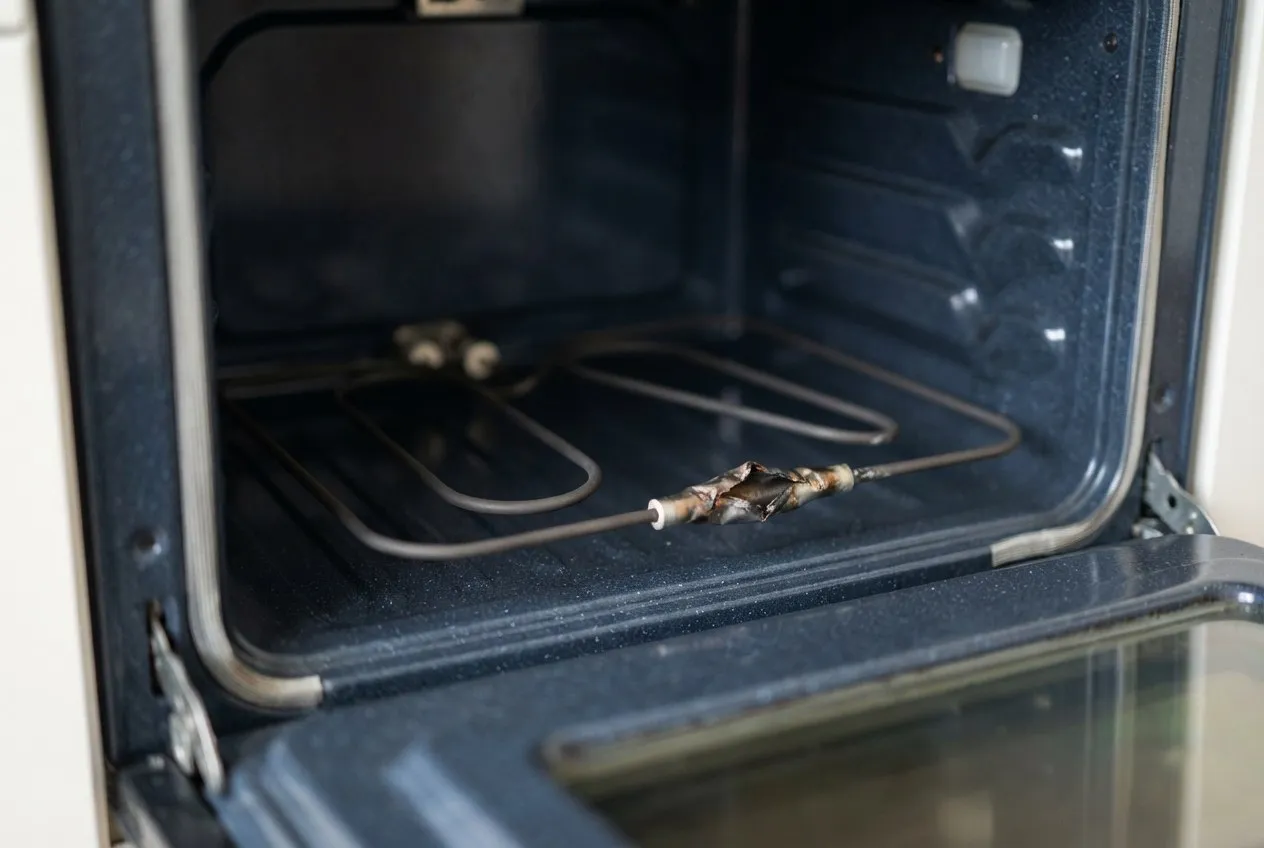
Look at the bake element with the oven off and cool. A blister, a split or a burned spot on the element is a clear sign it has failed. HomeGuide notes that ovens have two elements, bake and broil, and when either burns out or cracks the oven can’t heat properly. If the elements look fine, the fault may be in the sensor, the control board, or the wiring between them.
It heats, but food burns or comes out raw
A range that preheats and then misses the set temperature usually points to the temperature sensor or the thermostat. HomeGuide describes a failing sensor causing the oven to overheat or never reach its setting. Before paying for a part, put an oven thermometer on the middle rack and compare it with the display after a full preheat. That reading is useful information for the technician, and it separates a real temperature fault from a recipe problem.
The display is blank or shows a code
Turn the breaker off for a minute and back on; GE lists that as the way to reset an electronic control. If the display returns with a fault code, write it down along with the model number from the tag (usually inside the door frame or behind the storage drawer). Codes mean different things on different brands, so a code only helps when it’s read against that manufacturer’s documentation. Once you have the code, the appliance error code library is the place to look it up.
The door won’t close or unlock
A door that won’t seal lets heat escape, and a door stuck locked after a self-clean cycle stops the oven from being used at all. HomeGuide prices a full oven door assembly at $175 to $700 installed and oven-door glass at $125 to $500, with designer-oven doors costing more.
Stovetop problems on a range
The burners on top of a range are usually cheaper to fix than the oven underneath. On a gas range, a burner that won’t light after the stove has been cleaned is most often wet or has its cap sitting on the wrong burner, and it should light again once everything has dried and been reseated. GE treats continued clicking after that point as a service call. A worn surface igniter is a modest repair: HomeGuide lists $100 to $200 for a gas stove igniter.
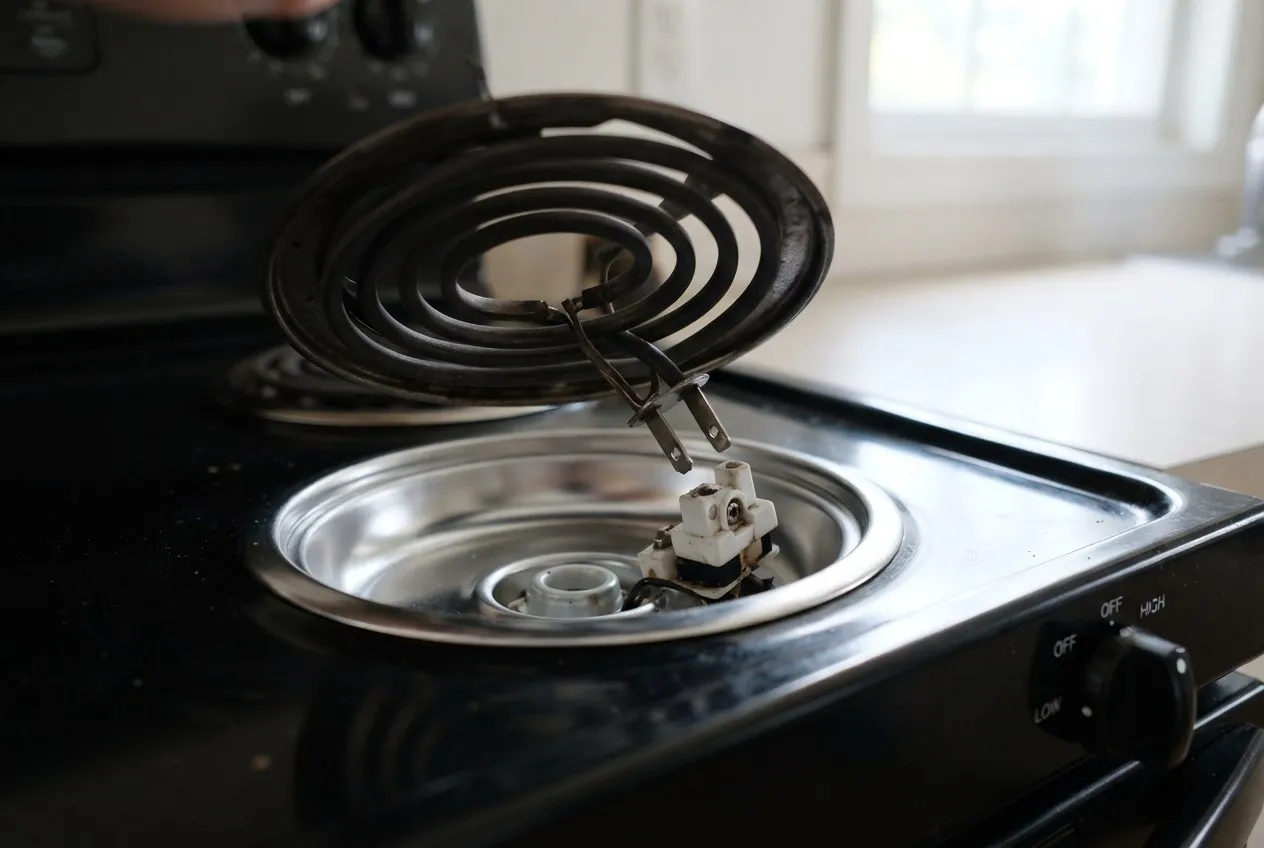
Electric coil ranges are simpler still. A coil that stays cold on every setting has usually burned out, and HomeGuide notes that replacement is the only fix for a burned-out element. Glass-top cracks, induction zones and separate cooktops get their own treatment on the cooktop and microwave repair page.
What oven repair and stove repair cost
These are national figures from HomeGuide, so treat them as a guide to scale rather than a quote for your kitchen. Labor is quoted at $50 to $125 an hour.
| Repair | Typical installed cost |
|---|---|
| Most single-part oven repairs | $150 to $350 |
| Gas oven igniter | $150 to $325 |
| Bake or broil element | $150 to $450 |
| Temperature sensor | $100 to $250 |
| Thermostat | $100 to $350 |
| Control board | $150 to $600 |
| Gas oven valve | $150 to $400 |
| Gas stovetop igniter | $100 to $200 |
| Coil surface element | $90 to $175 |
| Glass stovetop replacement | $200 to $1,000 |
Pro-style and built-in ranges from brands such as Wolf, Thermador and Viking use their own parts, and HomeGuide notes OEM door parts on designer ovens can reach $1,200 on their own. For a side-by-side look at other appliances, see the appliance repair cost guide.
In California, the paperwork matters as much as the price. The Bureau of Household Goods and Services (BHGS) says businesses that repair major home appliances must hold a BHGS registration, and that consumers must receive a written estimate with the total cost before the repair, though a diagnostic fee may apply first. Ask on the phone whether that fee is credited toward the repair if you go ahead, and check the company’s registration on the BHGS site before the visit.
Repair it or replace it?
HomeGuide gives a well-maintained oven or stove a life of 10 to 20 years and says gas appliances tend to outlast electric ones. Its rule of thumb: fix a range that’s under about 10 years old when the repair costs less than half the price of a new one, and lean toward replacing when the range is older and the repair would pass that 50% mark. A new oven installed runs $700 to $1,600 on HomeGuide’s figures, which is why a $200 igniter on a sound range is almost always worth doing.
The same 50% test tends to favor repair on expensive equipment. The pricier the replacement, the larger the repair bill has to be before it crosses that line, so a control board or valve on a pro-style range often still passes. Our repair or replace guide walks through the math for each appliance type.
Before the range goes back against the wall
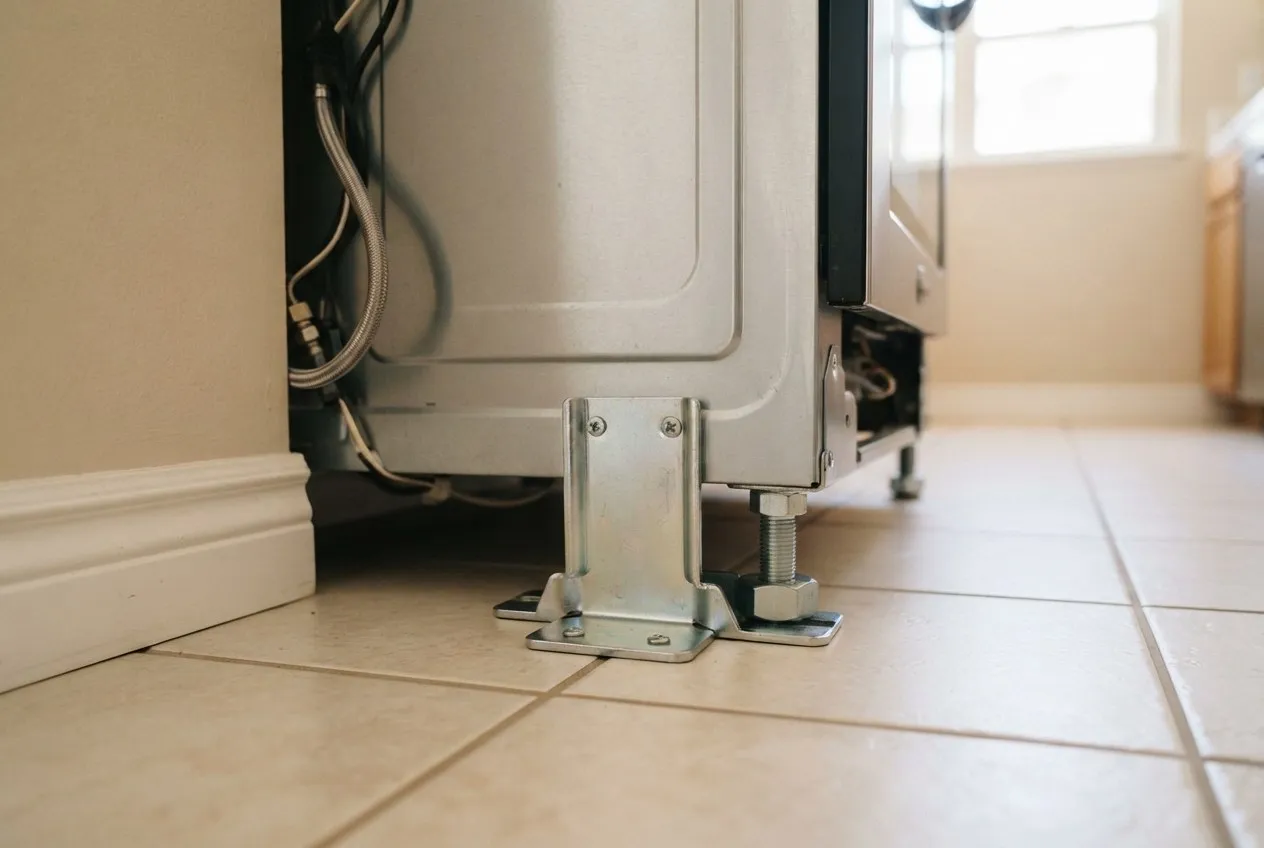
Any repair that means pulling the range out is a good moment to check the anti-tip bracket. The U.S. Consumer Product Safety Commission reports an estimated yearly average of 1,700 appliance-related instability and tipover injuries treated in emergency rooms for 2006 through 2008, and 13 deaths tied to stove, oven and range tipovers reported for 2000 through 2008, many involving children under 10. Voluntary standards require manufacturers to supply the bracket with new ranges, and the CPSC says some manufacturers will send a replacement at no charge if yours is missing. The bracket should be fastened to the wall or floor with the range held securely in it.
Two habits from PG&E are worth keeping on a gas range, too. Never use the oven to heat the house. On older ranges with standing pilots, if a pilot is out, shut the gas at the appliance valve and wait five minutes for gas to clear before relighting.
Getting the right company for your range
Oven and range repair covers everything from a basic freestanding electric range to a dual-fuel Wolf, and not every company stocks parts for both. When you call San Jose Appliance Care, have the brand, the model number, the fuel type and a one-line description of the symptom ready. We’ll connect you with a local company that works on that kind of range in your part of the city, or in neighboring Santa Clara, Cupertino and the rest of our service area. Ask them about the diagnostic fee and the written estimate before the visit is booked.