A repair quote lands, and the number feels big. Is it smarter to repair or replace the refrigerator, or the washer, and put the money toward something new? San Jose Appliance Care connects people across San Jose and nearby Santa Clara County cities with independent local repair companies, and the most useful thing a technician gives you is a real diagnosis and a written price. This guide shows you what to do with that price: how to test it against the 50 percent rule, how much life the appliance likely has left, and when the usual math doesn’t apply.
The 50 percent rule, and where it comes from
The rule of thumb most people quote traces back to Consumer Reports, which has advised: “don’t spend more than 50 percent of the cost of a new product on repairing an old one.” HomeGuide’s cost guide uses the same line and adds age, saying appliances more than 10 years old or with repairs costing more than 50% of a replacement typically aren’t worth repairing.
Applying it takes two numbers, and both need to be honest ones.
- The full repair price. Parts, labor and the service call, from a written estimate. A diagnosis over the phone isn’t a quote.
- A comparable replacement. Same size, same configuration, similar features. Comparing a French-door fridge repair to the lowest-priced top-freezer on the floor makes almost any repair look bad.
Here is how the math moves with the appliance. Consumer Reports found a median compressor repair cost of $562. HomeGuide lists new refrigerators at $600 to $2,300 for the unit alone. That same compressor job is under half the price of a $1,500 fridge and nearly the whole price of a $600 one.
The rule has blind spots. It ignores how much life the appliance has left, it ignores installation and disposal costs on the replacement, and it breaks down completely on built-ins. The sections below fill in those gaps.
How long each appliance usually lasts
InterNACHI, the home inspectors’ association, publishes a life expectancy chart for home components. It assumes normal use and maintenance, and InterNACHI presents the figures as guidelines only.
| Appliance | Expected life (InterNACHI) | Service page |
|---|---|---|
| Refrigerator | 9-13 years | Refrigerator and freezer repair |
| Freezer | 10-20 years | Refrigerator and freezer repair |
| Washing machine | 5-15 years | Washer repair |
| Clothes dryer | 13 years | Dryer repair |
| Dishwasher | 9 years | Dishwasher repair |
| Gas range | 15-17 years | Oven, range and stove repair |
| Electric range | 13-15 years | Oven, range and stove repair |
| Food waste disposal | 12 years | Garbage disposal repair |
| Microwave oven | 9 years | Cooktop and microwave repair |
A useful way to combine this with the 50 percent rule: the further past the midpoint of its expected life an appliance is, the lower the share of a new price you should be willing to spend. A $300 repair on a four-year-old dishwasher buys years of use. The same $300 on a nine-year-old one may buy months.
Repair or replace: refrigerator age, parts and energy use
Consumer Reports says a refrigerator under about 10 years old is usually more economical to fix, and it adds a useful nuance. A $400 top-freezer model approaching 10 years is probably due for replacement, while a $1,200 French-door model at nine years is usually worth repairing. The purchase price of the fridge sets how much a repair is worth.
What failed matters as much as age. Consumer Reports member data puts the median cost of fixing an ice maker, a dispenser or a fridge that isn’t cooling at roughly $150 to $240. Those are the repairs that usually make sense even on an older unit. The expensive end is the sealed system (compressor, evaporator, condenser and the refrigerant lines), where HomeGuide lists compressor replacement at $700 to $1,250.
Repairs don’t always work the first time either. In the same Consumer Reports survey, 62 percent of refrigerator repairs succeeded on the first attempt and another 25 percent after two or more attempts. On an older fridge with a borderline quote, that uncertainty is a fair reason to replace.
Energy use is a smaller factor than most people expect. ENERGY STAR says certified refrigerators are about 9 percent more efficient than models that meet the federal minimum, and that recycling an old fridge and replacing it with a certified one can save about $150 over a 12-year life. The case gets stronger for older units: ENERGY STAR says a refrigerator more than 15 years old could be costing about $95 a year to run. If the old fridge is headed for the garage as a second unit, ENERGY STAR’s advice is to replace it rather than keep it running year-round.
Is it worth repairing a 10-year-old washer?
Often, yes, if the part is a common one. Consumer Reports puts a washer’s life expectancy close to 10 years on average, so a 10-year-old machine is at the point where the specific repair decides it. HomeGuide lists simple washer fixes such as bearings, a pump, shock absorbers, a lid switch or a drive belt at $100 to $400, and suggests considering a new washer when an expensive repair lands on a machine older than 10 years.
Consumer Reports’ own median repair costs, which exclude the service call, show why washer type matters:
- Front-load washers: about $158 to $214
- Top-load agitator washers: about $123 to $175
- Top-load high-efficiency washers: about $142 to $213
- Compact washers: about $186
The efficiency argument is stronger for washers than for fridges. ENERGY STAR says certified washers use about 20 percent less energy and about 30 percent less water than regular models, with a full-size certified model using 14 gallons per load against 20 for a standard machine, and lifetime energy savings of about $530. If your 10-year-old washer is a top-load agitator model, replacing it changes your water use more than your electric bill.
A practical rule for a 10-year-old washer: approve the repair when the quote sits inside that $100 to $400 band for a common part, and think hard when it runs well above it, especially if this is the second repair in a year.
Parts availability and California’s Right to Repair Act
A repair only makes sense if the part exists. California’s Right to Repair Act (SB 244) requires manufacturers of appliances with a wholesale price of $100 or more to make documentation, functional parts and tools available for at least seven years after the last date a model was manufactured. It applies to products first manufactured and sold in California on or after July 1, 2021, and it became operative on July 1, 2024.

For most homeowners that means a model built from mid-2021 onward should have parts available for years after it leaves the showroom. Older appliances aren’t covered, so on a 12-year-old machine it’s worth asking the technician whether the part is still in stock before you approve the diagnosis.
Sub-Zero and other built-ins follow different math
The 50 percent rule assumes you can walk into a store and buy a comparable replacement. With a built-in Sub-Zero refrigerator, a panel-ready dishwasher or a pro-style range, you usually can’t. A new built-in has to fit the existing cabinet opening, may need custom panels to match the kitchen, and involves installation that a freestanding unit doesn’t. That pushes the replacement cost so high that a large repair often still clears the 50 percent line.
Warranty terms change the math further. Sub-Zero’s residential limited warranty covers parts and labor for two years from installation, parts and labor on the sealed system for five years, and sealed system parts (compressor, condenser, evaporator, drier and connecting tubing) from the sixth through the twelfth year. Check your own warranty paperwork, since terms differ by product and installation date. A compressor failure in year eight could be a parts-covered, labor-only repair.
Before you decide anything on a luxury unit, read the brand’s page: Sub-Zero repair, Wolf repair and Thermador repair cover what each manufacturer’s warranty includes. For what premium parts and labor tend to run, see the appliance repair cost guide.
Lean repair or lean replace: a side-by-side check
| Situation | Lean repair | Lean replace |
|---|---|---|
| Age | Under the midpoint of its expected life | Past the top of its expected life |
| Quote vs. comparable new | Under 50 percent | Over 50 percent |
| Failed part | Fan, pump, belt, switch, valve, igniter | Compressor or sealed system on a budget model |
| Repair history | First repair | Second or third repair in a short span |
| Appliance type | Built-in or high-end model | Low-cost freestanding model |
| Parts | In stock or covered by SB 244 | Discontinued, long back order |
If you replace: South Bay rebates and disposal rules
Two local energy providers offer rebates that can offset a replacement, mostly for electric upgrades. Check current status before you buy, since programs, amounts and funding change.
- Silicon Valley Clean Energy serves Cupertino, Los Gatos, Milpitas, Mountain View and Sunnyvale, among other communities. Its rebate list includes an induction cooktop or range rebate of $500 when you replace a gas unit ($750 for income-qualified customers). Check current status.
- San José Clean Energy runs a Home Appliance Savings Program for its customers in San Jose. Check current status and the eligible appliance list on its site before you buy.
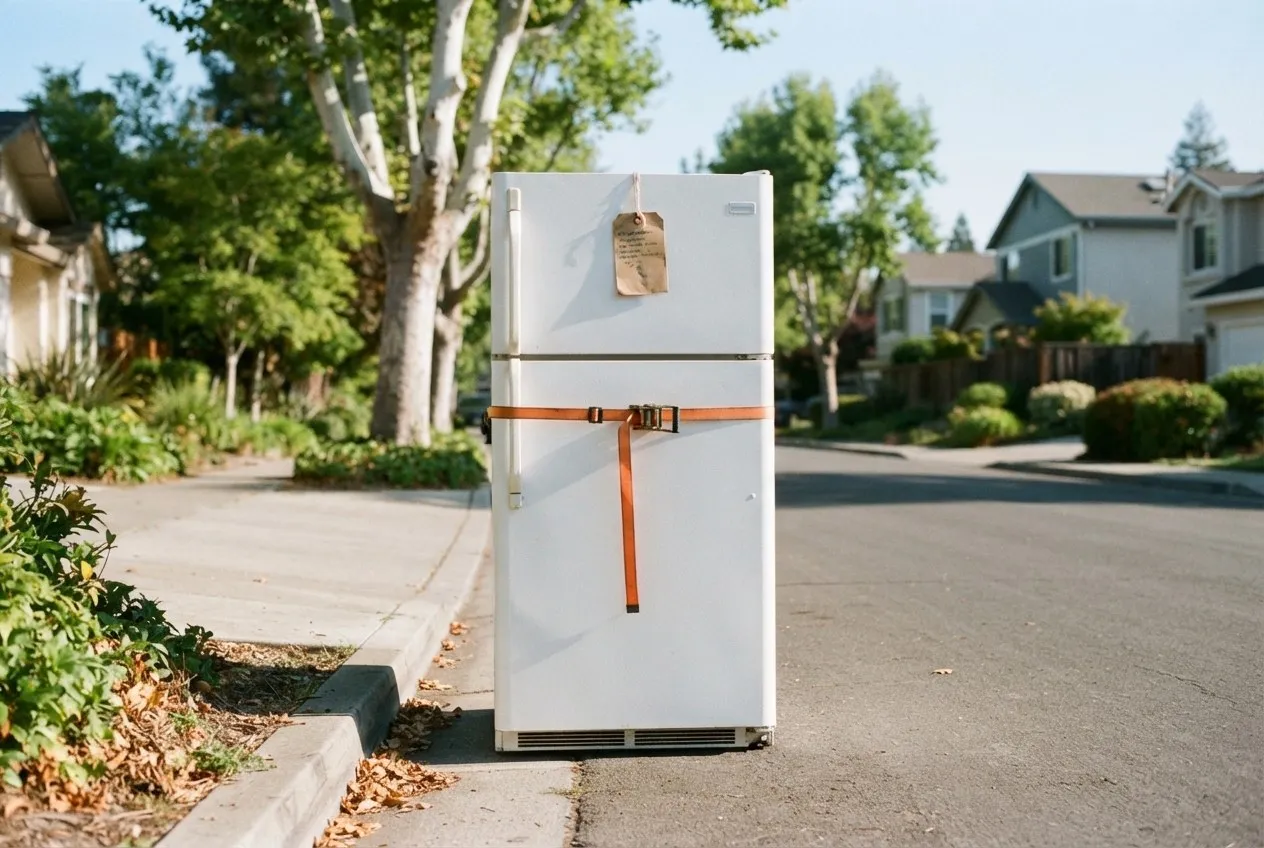
Getting rid of the old appliance has rules too. California requires materials that need special handling, such as refrigerant and mercury switches, to be removed from discarded major appliances by a Certified Appliance Recycler before they’re crushed or shredded, under the Department of Toxic Substances Control’s program. That’s why an old fridge shouldn’t go in a dumpster.
For San Jose homes and mobile home parks, the city offers free curbside large-item pickup scheduled through San José 311, and refrigerators, freezers, washers, dryers and dishwashers are on the eligible list. Apartment and most condo residents go through their property manager or hauler instead. ENERGY STAR also notes that many retailers will pick up and recycle the old refrigerator when they deliver the new one.
If the numbers still point to repair, call with the brand, model number and the quote you’re weighing, and we’ll connect you with a local company that can take a look.